

I started writing the poems in my first book, Small Talk, in 2019, in Tuscaloosa, Alabama. It didn’t occur to me that these poems were anything substantial until Kwoya, my mentor, said something along the lines of have you considered that you’re writing a book? (in her gracious and capacious way) a few years later. There’s a significant distance between writing poems and writing a collection, and it took me some time to find my own way across that space.
I haven’t always been grateful for these in-between intervals, those process periods, the weeds. Being on your way can feel a lot like being lost or worse, getting nowhere. Mostly, I’ll find myself feeling ridiculous for not recognizing that I’ve been in the middle of one sooner. I’ve come to develop a deep (if begrudging) appreciation for the process, recognizing that the inbetweeness is where everything that will happen starts to happen.
One of the joys of these periods has always been the company I pick up: an album, a book, an artist that found me on my way. They always seem to come at the precise right time. I’ve kept a copy of “Petition” by Brigit Pegeen Kelly taped to the bedroom door of every place I’ve lived since the day a beloved, the poet James Chung McKenna, offered the beginning lines to me: These are the long weeks. The weeks / Of waiting. Let them be / Longer.
Writing Small Talk was the way I taught myself waiting, but perhaps more critically, letting. I was in for some long weeks at the start: early on in both sobriety and transition, finishing school with no idea what might come afterwards.
During this time, I worked for a family run farm called Snows Bend. Nearly every Saturday morning, I woke at dawn to sell vegetables at the River Market or well before dawn to drive to Birmingham to set up shop there. During the week I’d come home from teaching and drive out to the land, swapping my car for the produce van to do mid-week deliveries, weaving a dolly piled with wax boxes through restaurant kitchens and Manna grocery.
Time dilates with certain kinds of work: olympic swimming pool lengths of tomatoes to prune, endless flats of green onions to plant, plastic crates of squash to haul and sort by size. I was lucky to work for and with kind, good people. Margaret Ann and David were bosses, yes, but also mentors. My coworkers were artisans, historians, parents, poets, musicians. We’d often stop work to admire a red-winged blackbird, to pour water for each other, to play songs off of someone’s phone carried around in an empty five-gallon bucket.
I also spent a lot of time alone. When I worked alone I could spend the day in a kind of trance, quiet but for my breath, or talking to myself the whole day through, or singing to the fields. Whether in the rows, the packing shed, the van, or the winter morning market, a stillness became available and it lit up my life with recognition. This wasn’t my first farm job –– I was no stranger to fish emulsion or tomato tar or long days in the heat, but I think my time on the Snow’s farm set up the conditions for all this big change to be something I tended to, was attentive to, and ultimately, let transform not just my life but how I experienced it.
Seasons happen slower when you’re out in them: the way an August morning starts to think about the summer ending, or how branches blur at their edges before they sprout new leaves. My poems started to think about space differently, and time. Stillness became something I sought to create within the structure of a poem; I wanted to find ways to manifest the atmospheres I’d found myself residing in: the fields, the woods and the rivers, but also the love, the conversations, and the room I was making in myself for it all.
In becoming more intimate with the natural world around me (learning names, building relationships with trees, making peace with the melon-stealing raccoons), I also had to confront what it might mean to truly acknowledge climate catastrophe and habitat loss. In keeping company with farmers, I had to reckon with the conglomeration of our food systems, the alienation and violence that affects all of us.
We call it paying attention for a reason: it costs something. I was writing to try to find a way to hold all of this. I still am. With Small Talk coming out in September, I’m back in an in-between. I’m not sure where the poems I’m writing now will take me, or if we’re going anywhere yet. The weeks feel long. But I know the answer: Let them be / Longer.
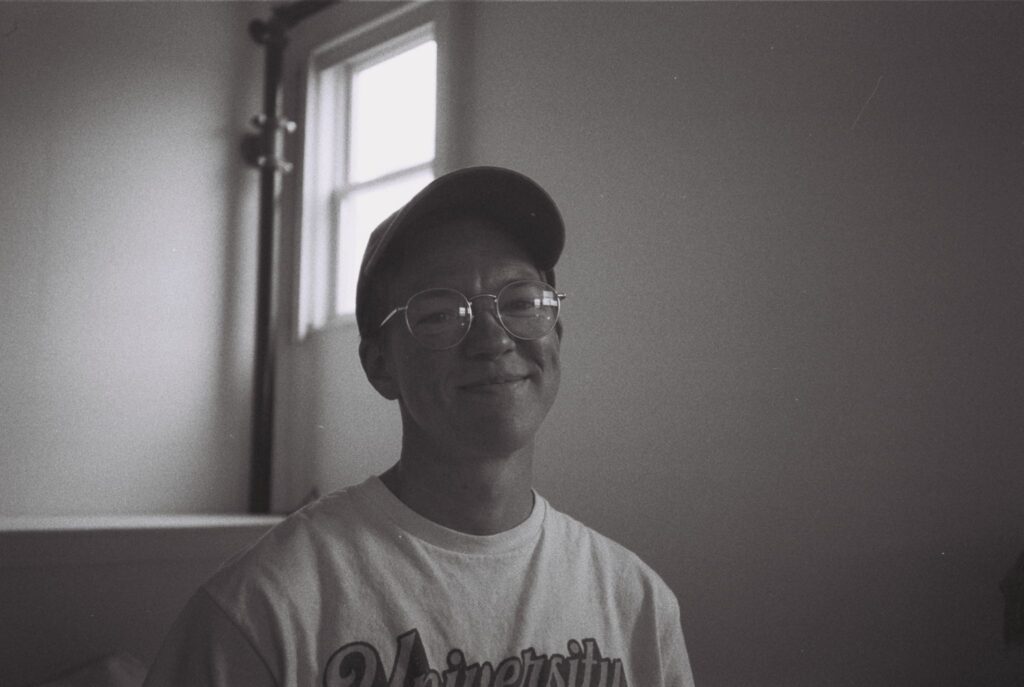
Acie Clark is a multi-genre writer from Florida and Georgia. His work has been supported by the Fine Arts Work Center, selected for Best New Poets 2025, and anthologized in Divinity in the Margins, I Witness, and The Florida Anthology. His debut collection, Small Talk, was selected by Derrick Austin for the New Southern Voices Poetry Prize and will come out with Hub City Press in September 2026. Recent work is forthcoming from Adroit, Strange Hymnal, the Louisville Review, and fourteen poems. He lives in Arkansas.
One response to “THE LONG WEEKS | by Acie Clark”
Well, I love this. You’re also writing a book of essays.