
The woods have a unique quiet. A silence, almost, but for the sounds of the whispering leaves as the wind caresses their surfaces. An occasional birdsong creates melody with the sounds of the breeze. My feet crunching softly on the dirt path are rhythmic, patterned, meditative. The light— chiaroscuro, a fractal sun dancing on leaves mottled with color of changing seasons—only adds to the solitary peace.
Why, then, is this the moment that a creative lightbulb moment happens? Suddenly, with no pen and paper available, an idea for an essay or the answer to a novel’s plot question appears in my thoughts—thoughts that just moments earlier were focused and mindful of the natural elements surrounding me.
Perhaps, the insight occurs when we are mindful. Mindful of our surroundings, of simply being, rather than the mindlessness we often muddle around in. Tapping into that inner place, the quiet center where creativity truly dwells.
When I started creating art decades ago, I wasn’t thinking about what I wanted to write or draw or photograph. It was simply something I had to do to survive the dysfunctional, violent household I grew up in. The words on paper, mostly poetry in those days, gave voice to the feelings I didn’t have the space or safety to say aloud. I wrote and created because I had to. Thoughts came from a space deep within, often arising during the rare times I could escape the inner city to a natural setting and simply breathe in air free from city smells and toxins.
I never realized until I studied and taught meditation where the deep well of creativity within me dwelled. The more I cognitively thought about what I wanted to create, the less successful I was. The more I understood that writing begins with the breath, the more authentic my voice became.
Language, of course, comes from the mind. Yet the real stories we must share, the memories of our lifetimes, are stored somewhere in our cells, waiting for us to reach within and tap into them. Perhaps it is the wisdom of ancestral history we are connecting to or the energetic place where intuition lives in our being. Paying attention to the breath, to the rise and fall of an involuntary bodily action, returns our focus to that deep well connecting the mind and body.
Meditation, at its core.
Hard to wrap your mind around, so to speak.
I presented this information once in a Zoom writing group, by leading the people in their tiny boxes through a mini meditation of sorts. Eyes closed, they all took one deep breath and then another. Coming back, I could see, even through the screen, the connection some were making, which was bringing them back to their center. The words they then shared about how this process was connecting them with the creative work they were doing was rewarding for me. It was a remembrance of sorts, about stepping back from technology into themselves, if briefly.
But I could feel the resistance of one particular man. If he wasn’t thinking, wasn’t planning, wasn’t doing for the pathway of his novel in progress, then how could it be? Because cognition was where creativity arose, right?
To be fair, in this writing group, we gather for ten minutes for a presentation, then write independently, and meet at the end for another ten minutes. There have been more days than I want to admit when I’ve been distracted from my work by all those things I can do on the screen, rather than connecting to my own work.
Yet when we get caught up in that “doing” and neglect the “being,” we never give ourselves the space or time to link fully with our deeper selves. Where thoughts go, energy goes. As we learn to focus on breathing in the moment, we become mindful of the scattered nature of those thoughts, allowing us to focus.
That space is easy to get caught in. Writing becomes less about expressing deep stories within and more about potentially publishing. Sharing our art with others is a worthy goal, certainly. Knowing that your creation has impacted another is beautiful. A writing center held a conference for a number of years called “The Muse and the Marketplace,” a name that resonated with this concept. How often are we so immersed with the marketplace that we forget the Muse that called us to writing to begin with?
When ideas come at somewhat inopportune times, like on a walk in the woods, or in the shower, or any of the moments when the brain is resting briefly and the spirit is rising, what do you do? I’ve dictated into my phone and written words into Notes on my phone (sans glasses, however, so that when I return home my words often require some interpretation). I have a waterproof notebook for the shower. Sometimes, I’ll scribble in a darkened room, eyes closed, notebook in hand. I often find that the act of pen and paper usually connects me better to that deeper place.
Other times, though, like the wind on those leaves, I just let it flow. Let the thoughts come and go, dancing like the light on the trees. My stories, my truths, are somewhere within, to be discovered again later, in a moment of stillness. With the breath.
So take a moment now. Close your eyes. Take a deep breath, focusing on expanding your diaphragm and abdomen. Let it out slowly, and as you do, feel yourself letting go. Try this for a breath or two. Do it for five minutes, or twenty.
Rediscover that muse that resides within us all, waiting to be heard once again.
Read more of Susan’s work at Reckon.
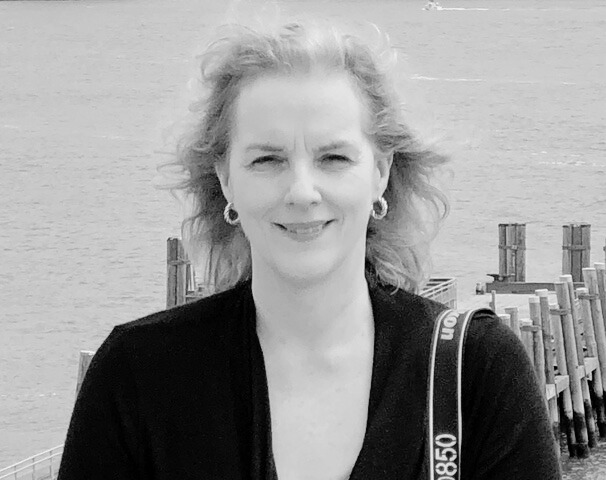
Susan Schirl Smith is a writer, photographer and holistic nurse living on the Seacoast of New Hampshire. Her essays have been published in WBUR’s Cognoscenti, Pangyrus, Silver Birch Press, Kind Over Matter, and the Porter House Review, among others. Her photography has been featured in Barren Magazine and L’Ephemere Review, along with local newspapers.
She has always been fascinated by the infinite possibilities of the world, and has owned a holistic wellness center, worked as a creative coach, designed websites, taught meditation and self-development classes, along with working in nursing in hospital and community settings. Her memoir in revisions is Desperado, a story of grief and hope, and the connection with loved ones that lasts forever.