
I am not Annabel Dixon of Apartment B-33, Building Four, Kralingen Street, Rotterdam. I was not born on May 11, 1988. I am not a Dutch woman carrying her ex-boyfriend’s child, on her way to Germany to get away for a while from the sickening arguments about whether to keep the baby growing inside her.
I stare straight into the airport officer’s eyes and firmly insist that I am, in fact, all of those things.
While I’m passing myself off as her, another officer appears from somewhere. I don’t know where. This one is a woman. Slightly overweight, with eyes so blue they eclipse the rest of her face. She walks calmly beside me and guides me out of the line. The male officer is a step or two ahead of us. The razor-sharp line of his haircut only makes his thick neck more noticeable.
They take my phone first. It’s empty. Spotless. I’ve even cleared the search history. They take my watch and my backpack too, though not at the same time. One after the other. I don’t have a belt. Just a pair of high-waisted jeans.
When I sit down across from them, I place my hands on my thighs.
“Please place your hands on the table. Both hands.”
The male officer says it. I can no longer see the sharp line at the back of his neck.
My mind immediately starts picking apart everything that comes out of his mouth. French accent.
I know my palms have gone pale. I mustn’t clench them into fists. I don’t lace my fingers
together either; the trembling would show. I lift both hands, half-open and side by side, and place them gently on the table.
My scalp has started to sweat. Whenever I sweat, the hair above my forehead curls up. I take a deep breath. Deep inside. From my stomach, I mean, so they won’t see it filling with air.
My stomach is hidden beneath the table.
I keep telling myself that eye contact matters. It matters a lot. I have to force the fact that I am Annabel into their eyes. Down their throats. Into their souls. Into every part of them.
I am Annabel. A Dutch girl. I speak English well, but I have a foreign accent. The Netherlands is foreign to Belgians too. There’s no reason for me to know French. This isn’t the German-speaking part of Belgium, either, so if things go bad, the few Dutch phrases I’ve memorized will probably be enough.
Things aren’t going to go bad.
This wasn’t one of those passports the smugglers in Victoria Park palm off on migrants. It had cost us far too much for that. My belly was getting bigger by the day, and I couldn’t afford to think about being exposed.
By the time you’re born, you’ll know a little of the Bible, a little Dutch, and you’ll probably know Athens like the back of your hand. I think that’s what Athens will be to you: a city where everyone has nightmares and everyone is thirsty. I woke from so many bad dreams with one hand on my belly while I drained a pitcher of water with the other.
You’ll even remember your Dutch father, the one who didn’t want you. Broad-shouldered and tall. Just like Ali, except blond, with freckles and brown speckles scattered across his arms and chest.
I’ve told you his story. Over and over. So many times, that sometimes I think that when you’re born and start talking, you’ll ask Ali why he doesn’t look like that.
“This passport was reported lost.” Reported lost.
Not stolen.
I run the words through my head again. My mind kicks into motion at terrifying speed. I pull away from the back of the chair and lean across the table. I open my hands.
“Yes. I reported it myself. I lost it last year. I was so stressed I reported it straight away. You know, I’ve never lost anything in my life. Not even a pencil, let alone a passport. I was furious. What really got to me was the feeling that I’d suddenly become someone who loses things. I lost my dog once too… God, that was awful…”
I was talking too much.
I toy with the pale mark where my ring used to be and lean back a little. Not all the way back into the chair, though.
“It turned up two or three months later. The passport, I mean. It had slipped into a tear in an old suitcase I wasn’t using anymore. I was so relieved to find out I wasn’t losing my memory that I completely forgot to report that it had been found.”
Then came more questions. About the street, the neighbourhood, the apartment where I lived in Rotterdam. About my ex-boyfriend. A thousand questions that would have ruined me if I hadn’t wiped my phone clean.
But I’m not ruined yet.
I’m still a long way from that.
For half a second, I clench my fists beneath the table and then bring my hands back up. I am calm. Composed. Like Annabel.
I had built Annabel in my head. You know Annabel too. Maybe one day you’ll see a woman walking down the street and call her Annabel.
The story of Annabel.
The woman who kept running in the mornings even when she was pregnant, who stirred honey into her turnips on winter evenings. Annabel sings in the shower, just like I do.
Afterward, she likes to lie on the bed for fifteen minutes with nothing on but a towel.
You even remember the plasterwork on our ceiling, little one. The ceiling of Apartment B-33.
Yes, I know the place needs fixing up before you’re born. Right now, I can’t afford to redo the whole apartment.
At night, the image of Building Four on Kralingen Street was the last thing I looked at before falling asleep on Google Earth.
I can feel my hair beginning to curl. They need to get this over with.
If they don’t, I’ll have to use you. I’ll have to put on a show.
I place a hand against my lower back and stretch. Body language.
Projecting anxiety. Controlling anxiety. Pregnancy tension.
I’ve wiped my phone clean.
I ask for some tissues and tell them that sitting for too long isn’t good for me.
The blue-eyed woman picks up a box of tissues from a small table by the door and sets it in front of me. Then she and the man leave the room. On her way out, she tells me to walk around for a bit if I need to.
I put together the next part of the plan in my head. When they come back, the performance starts.
There are cameras on both sides of the room. I begin right away. I make it look as though I’m overheated and uncomfortable. Just heat and discomfort. Not anger.
I turn my head from side to side and let my eyes wander in search of air. The room has no windows.
I sit down and rub my legs. Then I get up and start walking again. I hold a tissue over my mouth and pretend to gag.
They come back.
“Okay, Annabel. We’d like you to sign this sheet a few times. Anywhere you like. Just leave some space between the signatures.”
I don’t fall for it.
The fact that he’s calling me Annabel means nothing. He doesn’t have anything else to call me. Besides, they want me to think everything is fine so I’ll let my guard down.
I think of Ali. Of checking every scrap of paper covered with practice signatures. “Yes! Give me five… that’s it.”
We slapped our palms together. Danced around the room. Drank two beers to celebrate. I sign the page three times. Top. Bottom. Middle.
I hand it back without smiling and sit down.
The legs of my jeans cling to my skin with that dirty, feverish feeling. I hook a finger into the waistband and shift it a little. The room suddenly feels as though it smells. I breathe in, fast and deep. Fast enough to breathe every smell out of existence.
As stupid as that sounds.
When they finally let me go, I still don’t smile. I just start breathing through my mouth.
I press my legs together and make my way toward the bathroom in tiny steps. On the way there, I feel happy several times.
Happy and nauseous.
I gag.
I gag again.
I shove a finger down my throat. Deep. As deep as it will go. There’s nothing inside me to throw up.
Nothing except you.
I splash water on my face. Again, and again. Hard and fast. Until the mirror in front of me is covered in droplets.
Until I disappear from it.
People in the airport move as if someone has poured water into an anthill. No one can keep still. They rush from one place to another.
My brain is just as alert. As if I’ve taken something.
The sound of suitcase wheels scraping across the floor separates itself from everything else. I listen harder.
I want to hear that so-and-so made it through safely. That so-and-so called from Germany and said everything was fine. That they crossed so easily it was like driving through a toll booth.
I start entertaining myself.
The sun is blazing and it’s only four in the afternoon. I’m on my way to a vineyard near Takestan in Iran. We’re going to spend the day at someone’s vineyard in Takestan.
Then I remember we never actually said that.
We’d say, let’s go to so-and-so’s grape garden in Takestan. How ridiculous.
I buy a kilo of Armenian cucumbers from the vendors weaving between the rows of cars and bite into them without even washing them.
In an hour and a half, I’ll be sitting on the floor in Berlin. That’s how it’s supposed to happen.
The more people we find who are like us, the better we feel. It’s an unwritten law.
Like when one car pulled onto the shoulder and sped past the traffic, and then everyone else followed. Once they weren’t alone anymore.
A young blonde woman sits down beside me. Her hair is twisted into a messy bun, thin at the temples. From where I’m sitting, I can see the tattoos on her right forearm. Big flowers in bright colours.
I find myself wondering whether I should get a tattoo over my scar if I end up having a C-section.
A stalk of wheat might be nice.
Or a pair of Converse sneakers with crisscrossed laces. I know I won’t.
The woman shifts her hips back until the chair fills the hollow of her lower back. Not like me, perched on the edge of my seat, my belly hanging between my open legs as if it might slip right off.
The blonde takes out her phone and calls someone. She speaks softly. Not softly exactly—her voice isn’t quiet. Her tone is. Calm. Unhurried.
The only thing I understand is that she’s speaking French.
At the end of the call, she lifts the phone to her lips and blows a kiss to whoever is on the other end.
That isn’t me.
I get up and move a few seats away. Again, I sit on the edge of the chair. I’m not supposed to call Ali.
The plan is to call after I’ve made it through the final gate.
We’d been in Greece for three months by then. By then we’d stopped believing that bastard was ever going to move us an inch beyond Athens.
Ali had spent weeks tracking him down, poking his nose into every hole and corner he could find. The man never stayed in one place.
In the mornings, I’d gather the hairs he’d left behind on his pillow, pour him a cup of black tea gone stale in the flask, and hand it to him.
One day I caught myself thinking I’d take in the waistband of his trousers when he got home that night.
They hung off him.
When he came back, he wasn’t alone. There were three of them.
The bastard was with them.
And another man I didn’t recognize.
They threw him to the floor with his hands and mouth bound.
“I found a new smuggler. Not one of those useless drifters hanging around Ammonia Square or Victoria Park. A proper one. This piece of shit is staying right here until he pays back the money.”
I put a hand against the wall and stayed there.
The man I didn’t know had a shaved head and an earring in his right ear. Thin. The veins in his arms swollen. I could almost see the blood moving through them up, around, and back down again.
Ali tightened the black rag stuffed into the bastard’s mouth. The man pressed his front teeth harder against the filthy cloth.
The pulse in my forehead hammered wildly. Ali paced the room, talking nonstop.
Then, without warning, he pulled the curtains open.
Sunlight flooded the room and hit the bastard straight in the eyes.
A little later, the thin man got up and went to the bathroom. It was right there, maybe two metres from the apartment door.
He flushed.
A minute or two later, he flushed again.
“That guy’s muscle. Once we get the money from this asshole, I’ll give him his cut. This piece of shit is pathetic. One guy would’ve been enough for him. One of those quick little bastards. Do you know how many people gave up and went back these past few months? I’ll show you. You don’t get to screw us over and walk away, you son of a bitch.”
I was used to swearing by then.
Whenever Ali said this one or that one, his head swung back and forth between the corner of the room and the bathroom.
Then he went to the flask.
He poured two cups of black tea and set one down for the thin man, who had just come back from the bathroom.
The four of us lived in that room for three days.
Two metres from the front door, on the left, there was a cubicle with a toilet and a narrow stream of water pretending to be a shower.
Other people seemed to know about it too.
Once, someone came by with a bag of groceries, handed it to me, and nodded at Ali. The phone kept ringing.
Call after call.
I learned new swear words every day.
Whenever voices got louder, I put my hands on either side of my belly. I didn’t want you to hear.
Then people I’d never seen before came and took the bastard away. He was in pieces by then.
Ali handed me a new passport.
The plan was for me to make the crossing alone. He would come later.
We’d managed to get back two-thirds of the money.
I said goodbye to the people in that shabby, wide-open building.
A four-storey block of white cement where anyone could lower their head, slip inside, and disappear into one of its damp rooms.
Four floors wrapped around a long balcony strung with black clotheslines. Laundry hung everywhere.
You were always pushing your way through it, ducking your head as you made for your room.
The clothes never stayed clean.
Back then, every time Ali came home, he’d say someone else had gone back.
There were so many of these someone else’s that I started to feel as though we were swimming against the current.
“Ali, when are we going back?” I asked. “This baby is due in two months.” He didn’t answer.
He turned his back to me and went to sleep.
A few days later, he came back with the thin man and the bastard.
I start walking toward the final gate and spot the plane through the floor-to-ceiling windows. I slide both hands beneath my belly and lift it slightly.
You should see it too.
I move my hand across my stomach, searching for yours so I can hold it. I’m terrified.
I’m so afraid.
I have to make it to Germany. Then England.
Then Ali has to come. And then you’ll be born.
Every day, you grow a little bigger inside me.
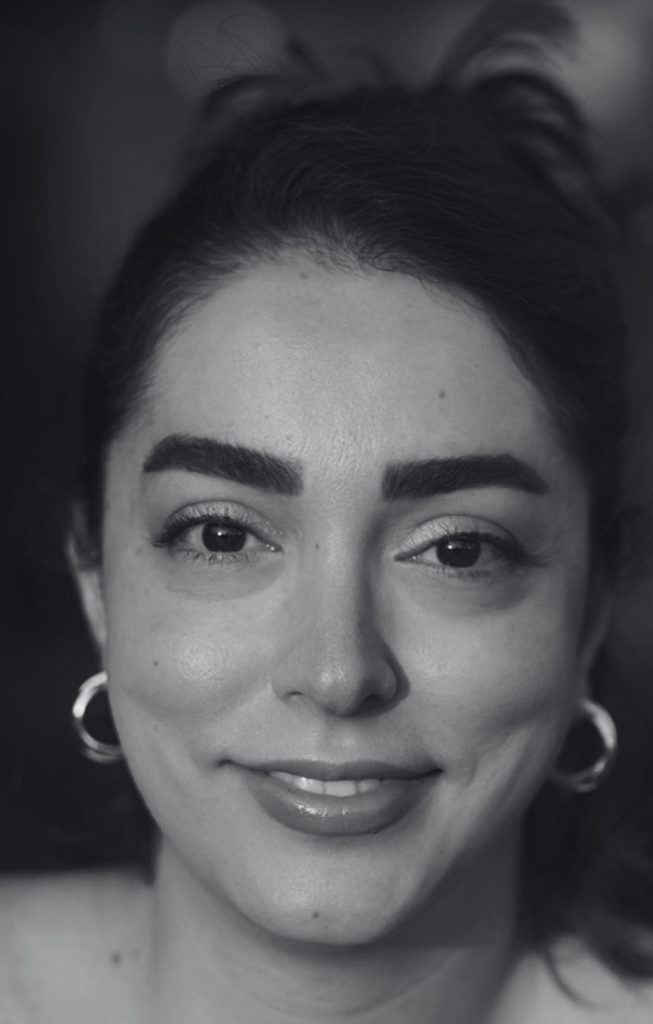
Mahsa Ghafari is an Iranian writer based in London. Her work won the Garnet International Short Story Award and has been shortlisted in other Persian-language literary competitions. She recently completed the Granta Intermediate Short Story Course and writes fiction in both Persian and English.