
I am in the back of Dollar General. I need an ice cube tray, a mop, and a bucket. I need markers in primary colors. I am in the kitchen section considering a spatula when, just to my right, in front of the bins of aluminum foil and plastic wrap, a wolf sits on his haunches. Or hers. I don’t know how to recognize a wolf by sex. I look away. I don’t think it is correct to see a wolf in Dollar General but he is still there, in the corner of my eye. He looks me up and down and yawns, his nose stretching upward and his yellow eyes squeezing shut for a moment. I turn to face him, but he’s vanished.
I choose a plastic ice cube tray to replace the cracked one that leaks a small icy puddle into my freezer. The store is crowded now with people pushing carts too big for the aisles. As I make my way to the cleaning products, I catch a glimpse of the wolf slipping deftly between wheels and feet. I look up at the faces of the other shoppers, but no one seems to notice him.
There are four choices of mops and two options for buckets. I choose the biggest bucket, plastic and purple, and the mop with wide ropes of white microfiber that claims to be washable, and head to the check out.
“Did you find what you were looking for?” the cashier asks. “Yeah.” I answer. And then add recklessly, “Did you see the wolf?”
“Oh him.” They peer down the aisle behind me. “He’s been here a while now.”
I’m not sure what response I was expecting. Denial, maybe, but not casual indifference. “But people—don’t they freak out?” I ask.
“Sometimes,” she answers, “When they manage to look up and notice him. But they get used to him, I guess.” The cashier glances at the line forming behind me. “I’ve got customers,” she says and waves me toward the exit.
I walk into the parking lot to my car. The mop and bucket take the passenger seat. I turn the key in the ignition, flip on the AC, and lean my head back on the chair. My eyes ache. Wolf at the door. A wolf in sheep’s clothing. Big, bad wolf. I appreciate symbolism and metaphor, but my brain bends hard toward the literal.
Today, a wolf at the dollar store. Last week, a pair of raccoons leered at me around the edge of a counter in the corner coffee shop.
On the drive home, my attention wanders, but my brain and body remember the way. I turn at all the correct intersections. On the radio the narrator-in-chief is spinning a tale. The President is your best friend and protector. The children behind razor wire are not like your children. There are no children at all behind the razor wire. Your job pays better than ever. The nurse is a terrorist. The lost cause is a victory.
When I pull up alongside the house, I feel a pang about the absence of the small red Chevy Fiesta I parked there last month. I had left it precariously close to the blackberry bushes that spill out at the end of the fence.
On the first day, the brambles crept around the wheels and over the driver’s side mirror. The next day, the canes extended over the windshield and the tip of a delicate vine began to work its way into the crevice between the driver’s side door and the body. On the third day, an enterprising tendril eased over and picked the lock. On the fourth day, a muscular creeper pried the door all the way open and the vines crashed in like a swollen river overcoming its banks. By day five, the bramble consumed it from the inside out, and it was gone.
I have to message L. and tell him I can’t sell the car for him after all. I feel badly, because he needs the money, starting over thousands of miles away. But I think he’ll understand. With so much disappeared already, including himself, the car is just one more anomaly.
The only path out of endless detention for L. was expulsion. No matter the pending asylum claim, or the lawlessness and terror of being dragged out of one’s car at the side of the road by paperless, armored men shouting from mouthless faces.
He and his wife came here for the kids. When I met the kids, I understood the imperative. The girl, whipsmart, full of big sister energy. She explained that she could speak three languages, thanks not to schooling but the many places she’s been forced to make into home, then mentioned casually that she had a new classmate who speaks Russian, so she’d decided to learn that too, between track practice and debate club. The little boy was bright-eyed and fast moving and full of big ideas.
Eventually the parents, considering the non-options, decided they would all leave together; no separate continents. I was told that the news made the small boy cry. But he soothed some as his mother assured him that the path home would not be a repeat of the fevered journey of their arrival which included a 6 day walk through a jungle full of death and desperate hope, with a parched throat and itchy bites and simmering infection and unanswered questions that must run through a child’s mind, ending at a cold, damp tent in a Pacific Northwest churchyard.
Now they are gone and things have been left behind. People are responsible for their disposal. I feel I’m overstepping my bounds with the car. It’s an intimacy out of place. Its owner and I don’t really know each other at all, just jostled together by personal disaster and availability of a parking spot. Maybe that is why the brambles ate the car. It never belonged here anyway.
It’s getting uncomfortably warm parked in the sun. Gathering up the computer bag I had tossed on the floor and the new ice cube tray, I climb out of the car and kick the door shut with my foot. As I turn and walk around to the passenger side to grab the mob and bucket, I catch a glimpse of red peeking out just behind my neighbor’s grey truck with the mismatched fender. The small red car is there. Of course the brambles didn’t eat it, how could they? I touch the car as I walk toward the house, it’s solid enough. Relieved, I text the friend who knows its owner better, to ask how much we should sell it for.
The house is cool and quiet. I dump the bucket and mop on the floor and the bag on the kitchen table and fill the ice cube tray with cold water from the faucet. What bothers me about the wolf, beside the mere fact of him, is how unconcerned he was. His surety was unnerving. The Dollar General is not the territory of wolves.
I wish I had asked him a question, although I already know the answer.
“What are you after?” I ask the air in my kitchen although I already know the answer
All of it.
The raccoons are another matter. Wiley buffoons out for their own shiny prizes. Next thing I know they will be sidling up to the coffee counter taking my favorite beverage from my hands. “For me,” they’ll say cheerfully, with slightly bared teeth.
I place my filled ice cube tray in the freezer. I appreciate its solidity and how the water stays where I put it. In a few hours I’ll have full size ice cubes. I pick up the sponge from the side of the sink and wipe the crumb covered counters clear. The floors need cleaning. They will have to wait.
I sit down at the kitchen table and open my laptop to write. The dirty floors look up at me with reproach. Half of writing, some people say, is putting your butt in a chair. Half is unfortunately, only half. I click open a new tab. The internet informs me that a group of raccoons is called a gaze, which doesn’t seem like it could be true at all, but is a fact.
I don’t think I’ve told you anything that isn’t true. Even if the car is still here today, coughing to life when I put the key in the ignition every now and again. The car, left behind, is an unstable representation of the car that it was. Tomorrow it will be gone, consumed by brambles or sold away to another man who will drive it to another job. Will he feel uneasy in a way he can’t put his finger on as he slides in behind the steering wheel? He might. A person plucked from one reality to another, that leaves some kind of mark—a scent, an echo, a story hovering over the hood like mist.
A gaze of ravenous raccoons may have taken up at the neighborhood coffee shop. Next time I sit down with my latte one of them will peer at the lighted screen of my laptop over his caramel macchiato. The wolf is at home in the aisles of the Dollar General. The scattered glass on the asphalt is from the window of a car, smashed by men who took a person. They drove away with him in the back of an unmarked car.
When I find my capacity for attention faltering, I ground myself in small, sensible things. I place the purple bucket in the sink, turn on the tap, squeeze in a glop of gooey liquid detergent, and swirl the water around with my hand until suds bubble. I plunge the mop in and splash it to the floor. Back and forth, section by section, I wipe it clean. I pull the ice cube tray from the freezer, drop the freshly solid cubes into a glass, and fill it to the brim with water. Glass to my lips, I feel the cold, clear liquid pour down my throat.
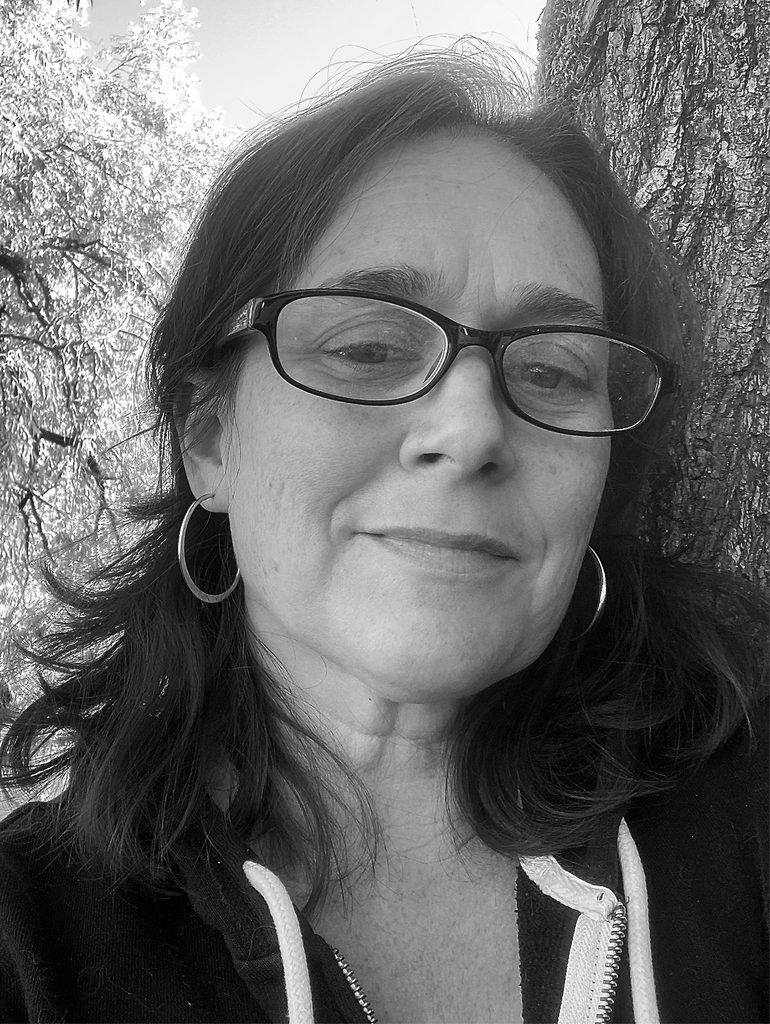
Siobhan Ring was raised in a small town in the foothills of the Adirondack mountains. Her creative non-fiction has been published in The Write Launch, Lunch Ticket, and The Good Life Review. Her essay “Words” was a finalist for the Diana Woods Memorial Award. Siobhan lives and writes from the Pacific Northwest where she lives with her wife and son. When she isn’t writing, she is organizing for a world where all of us are safe and free.