
Nana says she has forgotten how to live. She says this plainly and calmly, as if stating a fact. She’s peeling an orange with her stained butter knife, her eyes on some beauty contestants mutely catwalking on the corner TV.
“The weather is nice today,” I say, but Nana turns to look at me like she has forgotten how to speak. She leaves the half-peeled orange on the table, her non-words sharpened into a sneer.
The next day, Nana forgets how to cream her hands, how to wash her face. I help her hunch over the sink, my palms treading the lukewarm water along the stanzas of her skin. After I towel her hands, she reaches over to touch my face with the same tenderness I tended to hers.
Some days, Nana looks at me as if she wants to say something important but can’t find the right words for it. Her lips move in slow gestures, like she’s trying to remember a song without melody. Whatever she says, I just nod along as if to emulate an understanding, as if some part of me can translate the tremble in her hands, the quiver in her breath. Before her passing, Mother had warned me that these things might happen, that Nana might eventually start coming and going between places. She’d instructed me on everything that I should do in those moments, on how I should treat Nana, how to be patient and gentle with her—Mother’s only request.
One day, Nana says she’s forgotten how the world is supposed to end. Not her world but the world as we know it. I tell her I don’t know either, that we’ll all probably be long gone by then. I think of everyone who prophesied the end of things: Mayans, Al Gore, Paul the oracle octopus. According to Mother, Dad too was blessed with second sight, able to see beyond the people’s shiny façades. I often wondered if that was why he left us, why I was unworthy of his love.
For days to come, I dream of alternative endings for the world, switching between all plausible disaster scenarios in my mind. One day it’s a biblical fire that brings down entire continents, and the next a world-bending earthquake. In all of my dreams, the only recurring motif is water—rising, covering, swallowing everything—but also washing, cleansing me of myself. I can’t even tell whether I’m drowning or simply being carried away. Or getting baptized in some bleak, divine way.
During breakfast one morning, Nana says she would like to go to Vegas before the world ends. Why Vegas? I want to ask but then stop myself. Instead, I tell her we don’t have to wait, that we can even hit the road today if she wants. For the twenty-seven years I’ve known her I never saw her leave her post in the house, let alone the state. The family lore has it that she was seventeen when she left her village in western Turkey, with little more than a borrowed suitcase and her mother’s blessings to her name. Her hands were wrapped around a small leather-bound Quran when she stepped on the ship that would take her to San Diego, a stone’s throw from the crowded marketplace where her uncle sold fülüt to tourists. The border officer who greeted her said she had a composer’s hands. Two months later, they got married in a roadside chapel outside Monterey.
The following morning, I prepare us two sandwiches, along with a few pieces of sarma wrapped in wax paper. Nana is quieter than usual, as if her silence is just another thing she’s packed for the road. We only communicate in questions—Where’s the sunscreen? Did you pack your pills?—and at one point I tell her about the route we’ll take, about the deserty towns that will zoom by like a mirage, but she mostly doesn’t reply. She checks the sky every so often, as if trying to make out a message from the clouds.
——
I drive us east toward Barstow, telling her instead we are headed to Vegas. Each town we pass through seems either like an expanded or a condensed version of home, with a slight alteration here or an additional store there. Some thunderstruck trees along the way look hollowed-out and gnarly like Nana’s body. I just hope the road signs won’t betray me, switching between languages every few towns, leading everywhere but Nevada.
“I forgot what the desert looks like,” Nana says as we pass a billboard for addiction awareness. I put on Emmylou Harris’ Red Dirt Girl, Nana’s favorite, and we watch the road lines stretch beneath the car in silence.
We pull into Barstow just as the sky begins to unravel into the colors of Americana. The hotel is a squat, pinkish building with sun-faded stucco and a large sign that hums with neon. The whole compound looks more like a strip club from afar. A plastic palm tree leans half-heartedly over the entrance, its fronds rattling like chimes in a windstorm. When I kill the engine, the silence between us settles awkward and thick. Nana sits still beside me, her hands folded neatly in her lap, eyes on the clouds, as if waiting for some kind of divine intervention.
The first thing Nana wants to do upon entering the hotel is play the machines in the lobby. The heavy husk of incense and stale sweat welcomes us as the sliding doors open and close with metronomic precision. On our floor, she runs her hands over the spare towels and fruit bowls on the trays dispersed across the hallway, trying to remember how to entertain herself. Mother used to tell me that Nana was a master of manipulation back in her heyday, that she could read people’s faces in the same way some people read books. She could tell at a glance who was bluffing and who was hiding something, which was probably why she never liked Dad. In our shared hotel room, she takes the larger bed by the window, watching the sky turn into an aftermath of purple and red.
“You always overpack like your daughter,” she tells me, probably mistaking me for Mother, reaching for my suitcase instead of hers.
——
The dining hall smells like old grease and something intensely floral as if someone tried to cover something bad with something worse. A lone TV in the corner hums a muted infomercial for secondhand treadmills. A man in a sweat-stained baseball cap stirs sugar into his coffee at the next table, mumbling something as though he’s casting a spell. I take out our turkey sandwiches sealed in sticky plastic triangles and a pair of sodas I took from a sweating fridge. I help Nana peel the bread apart slowly and methodically, flicking every piece of lettuce onto a napkin. “Too bitter,” she mutters, watching me perform a little surgery on her sandwich. Mother, too, used to be critical of most things like Nana—too sharp this, too soft that—but never the middle of anything, pretty much like everything else that defined her.
Later, in the main hall, Nana settles into one of the slot machines as if it’s her favorite armchair, eyes squinting at the flickering screens. The first few pulls are casual, just a hesitant warm-up. As time stretches on, her focus sharpens like she’s trying to decipher a code only she can see. She still remembers how to chase after hope, what the fleeting taste of luck looks like. At some point, she forgets what she has been playing for, maybe just the sound of those coins, or the belief that if she keeps pulling, something will eventually change.
At a machine called Buffalo Triple Power, she stops moving mid-pull and looks up at me like a confused child.
“I’m sorry about Mother,” she says, and I falter. I can’t tell whether she’s talking about my mother or her own.
“It’s okay,” I reply, then help her to a vacant stool by the machine. “Come on.”
I tell her to wait up for me, and then excuse myself. I smoke two cigarettes by the dumpsters out back, lighting the second one before extinguishing the first. All my life, I knew Mother as a chain-smoker who painted our house in a fog of secondhand gray. Every time she coughed, she told me not to worry, that we were immortal as a family. On the night of her diagnosis, she joked that she should start sleeping with the lights on from then on, that the day I see them off would be the day I should call the ambulance.
The casino looks more crowded when I step back in, sans Nana. The stool where I left her is now occupied by a young woman in a three-piece suit who’s scrolling disinterestedly on her phone. I wander along the aisles to find Nana. I scour the floor for her telltale red shirt, her hunched silhouette, anything familiar amid the blur of strangers. Wherever I look, I’m always a second too late, and she’s long slipped between the flickering frames of this labyrinthine place, leaving only a shimmer behind—something seen only in passing, in the periphery of my vision, yet never head-on. She’s everywhere and nowhere all at once—is and is not at the penny slots; is and is not by the quarter machines—existing just in-between, like a stuck coin.
In the adjacent hall, I spot a chapel amid the cluster of neon signboards, well-dressed magicians, and blinking screens. It’s a quiet sanctuary tucked in the chaos of the casino, a beacon of calm. Rows sparsely filled with the repentant, their heads bowed and hands met in supplication. Never once in my life have I set foot in a church or a mosque, let alone by choice. Not even after Mother died. Today, something about the silence here feels like an invitation, or maybe a dare. It reminds me of hiding in the closet as a kid—dark, small, and safe enough to have a sip from Dad’s flask without anyone meddling in. My knees are cold to the touch as I kneel on the marble tiles. I want to atone for all my sins, for having lied to Nana. For not having said goodbye to Mother. I wonder who’ll hear me now—Jesus? The gamblers out there? Some slot-machine god?
And then, as if my prayers were heard, and answered, a soft mechanical hum rises in the background. The sound is barely there, like scurrying little footfalls of mice in a quiet room. One of the slot machines tucked in the corner of the chapel blinks to life, maybe triggered by a motion sensor or some timer nobody bothered to fix. I don’t turn to look but I can feel its lights pulsing in a slow, looping rhythm. Left to right, then right to left. Stubborn, rhythmic, in a language of ones and zeros that I can’t speak. Its music, composed of equal parts Emmylou Harris’ Red Dirt Girl in garbled, staticky notes and the generic hymnal loop of the casino.
My laughter is part sob, part surrender.
Back on our floor, the hallway looks so dim I can’t find our room for a moment. The numberless door on the opposite end resembles an unmarked tombstone, with no light seeping through around or under. The carpet stretches on with its dizzying pattern, a labyrinth of reds and browns that keeps pulling me forward and swallows me back at the same time. I feel the floor tilt beneath me.
When I reach the end of the hallway, I grab at the doorknob and leave my hand be for a moment. I think of the last day I saw Mother. I think of her withered smile. I think of our home and its narrow edges. I want to knock and ask Nana if everything is all right. I want to tell her that the world will end soon only to begin again, a million times over, our memories etched into each spin, waiting for us to reunite.
I press my ear against the door, holding my breath. I hope that if I listen too closely, I can hear her dreaming.
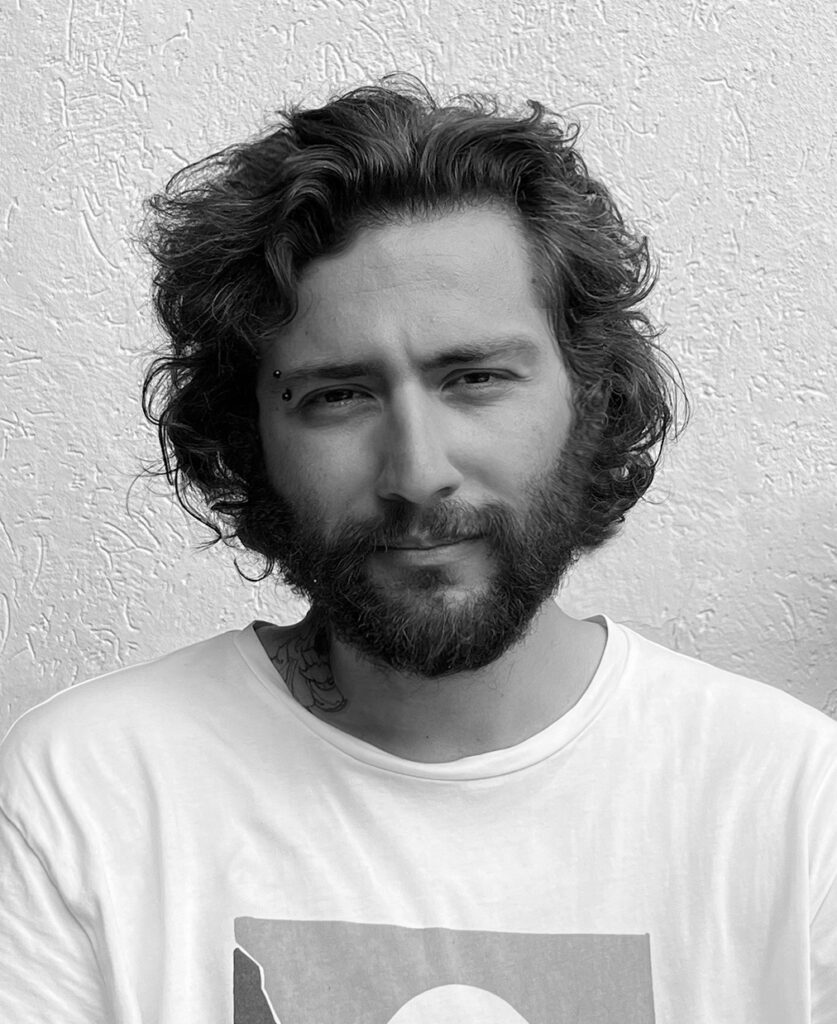
Sarp Sozdinler is a writer based between Philadelphia and Amsterdam. His work has found places in Electric Literature, Kenyon Review, Wigleaf, HAD, Hobart, X-R-A-Y, Burial, Flash Frog, Pithead Chapel, Fractured Lit, Maudlin House, and elsewhere. His stories have been included to anthologies such as the Pushcart Prize, Best Small Fictions, and Best Microfiction, and selected as finalists for the Los Angeles Review Short Fiction Prize and the Passages North Waasnode Short Fiction Prize. He serves as the editor of The Bulb Region.